READING COMPREHENSION, ARTICLES AND TEXTS ONLINE. WHERE?

Thursday, 27 September 2018 1 comment
Searching online for information, news, articles, and texts is not easy and accessible for everyone, but sometimes it requires time, maybe a long time. As teachers, we always try to find additional material that we can use in our classrooms because we know that authentic material is a good way to bring reality into the classroom. But sometimes the online research is time-consuming. So this is why I have my "favorite sites" for quick research and quick use. I have to say that this has saved me some time over the years. 

Where can we find age and level appropriate reading comprehension, news articles and texts for our students?

Here are a few sites that I have used and still use for my sources.

My TOP CHOICES:
This is a very useful site where you can find different types of news. Each article is presented with different versions and different levels of English. There also exercises related to the article and the chance to listen to the audio file of the article ( different audio files at different speed).
Very good site for English learners. News are presented according to categories and levels of English. 

Very good site with different news articles made into ready-to-download ( and free) lessons for teaching English. Not really updated recently, but still a very good site. 

Wonderful site with different reading comprehension. You can choose the grade ( level), the number of words, the type of product and the text type. Each text comes with audio file, vocabulary exercises ( in English) and comprehension questions. This site is for educators only and it is free of charge. This site is not specifically for esl/efl and can also be used to secondary school students. 

Very useful news search site for teachers. It has a pro version which is not free but by logging in with a free account the main features of the sites are still possible. There are different news divided into categories and topics. The search bar at the top is very useful as you can type any kind of keyword and the site easily directs you to the news about that word. The pro account gives you the chance to assign the articles to your students and check their progress.

You will need an official educator email to log in this site. I highly recommend it as it has a wide online library with reading passages divided by books, genres, level, literary device and theme. It is not specifically for esl/efl learners but all texts can easily be used and adapted. It can be used for all age levels and all language levels. 

Better for CHILDREN of PRIMARY SCHOOL
This site is for sport related articles. It is not a site specifically for esl/efl,  therefore some articles may need to be adapted. The interesting thing is that some articles are even written by kids.

A news site for children. News are divided into categories. Not specifically for esl/efl learners so articles may need to be simplified. Very good site. 

Use the search bar and type a topic to find information about it.


Better for SECONDARY SCHOOL STUDENTS AND/OR ADULTS

Various news articles, not specifically for esl/efl and better suitable for secondary school students or adults. 

Amazing internet archive which also works as a search engine and connects you to different sites. You can specify your research by clicking the boxes on the left and choosing the type of text, the year, the topic and the language. 

This is the best way to find free ebooks. Thousands of books are available for free use. 

STORY CORPS
Real life stories, told by the protagonists. Not specifically esl/efl site, but very interesting stories, especially for adults since this is authentic material. 

READER'S DIGEST
Real life news. Not specifically esl/efl site, but very interesting site, especially for adults since this is authentic material. 

PUBLIC DOMAIN ESSAYS
Ready to use essays on different topics, divided by categories. 


MANY THINGS
Many articles divided by topics, some with audio files. 

FOR THE TEACHER
Leveled Reading articles with very interesting lesson plans that might need to be adapted as the site is not specifically for esl/efl. 

Hope you will find these links as useful as I do. Try them and please let me know if you find others by commenting here or writing to me. Save these links as favorites for easy future access. Trust me, it will save you some precious time!

Thank you, 
Miss Alex


AIESEC EDUCHANGE 2017/2018: IN THE RIGHT HANDS

Monday, 10 September 2018 No comments
What happens when Australia meets California.... 
in Italy?
Well, we know what happens, it's MAGIC!
School main hall ready to welcome our 2018 AIESEC volunteers
For the 2017-2018 AIESEC educhange project we were assigned two female volunteers coming from Australia and from California: Amra Polutak and Tatiana Oropel.


The two girls had a hard time at the beginning getting adjusted to the Italian cold weather ( it was January when they arrived) and we could not blame them because they both came from hot countries. We do have to say that in spite of this difficulties the girls showed a very high level of spirit of adaptation. They were ready and enthusiastic about this project from day one and the project could not have started any better. 
All classes were involved, from the first year of primary school to the last year of secondary school and Tatiana and Amra were very flexible and easily adapted to the different ages. 
The first two weeks were dedicated to getting to know the volunteers and their country of origin.  
These are works done by the 4th and 5th year primary school


These are works done by the 1st, 2nd, 3rd year primary school
After these first two weeks the project focused on the chosen theme: CHILDREN'S RIGHTS.
Each class worked on specific rights:
- the 1st  and 2nd year PRIMARY SCHOOL worked on the right to have a NAME, an IDENTITY.
- the 3rd year primary school worked on the right to have a HOME, a  FAMILY and to receive LOVE AND CARE
- the 4th year primary school worked on the right to have WATER
-the 5th year primary school worked on the right to have FOOD and a HEALTHY LIFE
-the 1st year secondary school worked on the right not to be discriminated by a DISABILITY
- the 2nd year secondary school worked on the right of FREE EXPRESSION
-the 3rd year secondary school worked on the right to EDUCATION, on the right not to be EXPLOITED FOR WORK or FOR WAR
Teachers, volunteers, students, families and other school operators ( our headmaster, the president of our school, the administration office) worked together throughout this project and contributed to its success. 
On the final day, the primary school had the chance to know information about the other rights children have, whereas the secondary school worked on a booklet that put together information, worksheets and activities about all rights.
The project ended with two final very special moments: a farewell party in the morning with the students and a meeting with the families in the evening so that all parents had the chance to see and understand what had been done during the previous six weeks. 


Thank you to the people that made this possible, for the second year!
Thank you, 
Miss Alex

AIESEC EDUCHANGE 2016/2017: RIAMBIENTIAMOCI

Monday, 3 September 2018 No comments
         
This is the title of our AIESEC EDUCHANGE project for the school year 2016-2017. The title is the expression of the hope that we had and the goal that we wanted to reach with this project, that means to learn and study about the environment and about natural disasters and to go back to the natural world with a  more conscious and more careful approach.

The project was co-taught by the AIESEC volunteers with the help from the teachers of my school. The language of the project was English, so sometimes teachers needed to help the students to understand and manage the content of the lessons, even though the material prepared for the lessons had been chosen according to the students' level of English. Our volunteers for this project came from Sri Lanka and were two wonderful newly graduated teachers called Rishini and Dilshani.


The students and the teachers got to know them and got to love them during those six weeks. The first two weeks of their stay were dedicated to getting to know them and their county of origin: Sri Lanka


In these pictures students are trying to find information cards and pictures about Sri Lanka. Those pictures had been spread along the school corridors. The younger chìldren of primary school worked on a little booklet about Sri Lanka. 

Blended learning combined traditional teaching techniques and the use of technology in the classroom. 
These are some of the students' works after the first two weeks. 

From the 3rd to 6th week each class worked on a specific natural disaster: tornadoes, earthquakes, tsunami, pollution, volcanoes, animals in danger, climate change, rainforests, wildfires, flooding. Having Rishini and Dilshani in the classrooms explaining and teaching all this added an extra human value to these topics. I remember when Dilshani told our third year secondary school students about the Tsunami she experienced in Sri Lanka. I remember the silence and the attention that all the students were paying to her. It was such a touching moment. 
At the end of the 6th week we organised a final moment in the main hall. All the classes had the chance to explain what they had been working on. It was a precious moment in which all the work done by single classes made sense to form the bigger picture. 
The Aiesec Educhange project contributed to improve the English language communication but it also gave us a wonderful opportunity to get to know the culture of a country which seems so far away from us, but in reality it is not that far or that different from us. Strong ties were born during this experience: families invited Rishini and Dilshani over their houses for dinners, teachers went out with them, students invited them to hang out during the afternoon and, I was able to meet them again in the summer 2017 when I went to Sri Lanka with my husband! Those two girls were only Aiesec volunteers at the beginning of the project, but they became our special friends by the end of it! 


Thank you, 
Miss Alex

BACK TO SCHOOL MAGIC PARCEL GAME!

Saturday, 25 August 2018 No comments
How about a  "back to school" 
magic parcel game?

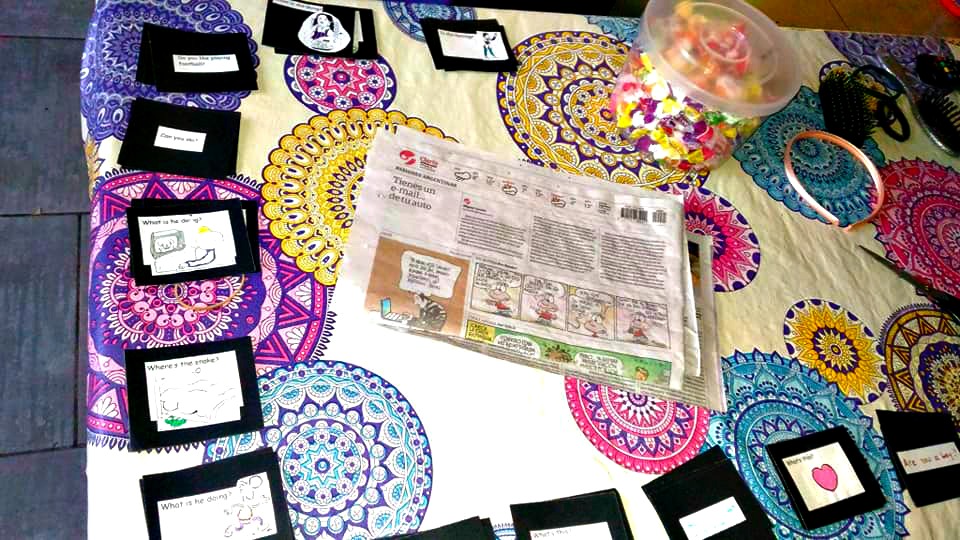
The idea is the typical magic parcel from birthday parties.
When the music stops, whoever receives the parcel has to remove a layer of paper. 
On each layer students will find a sweet and a question, to revise what had been done the previous year. If they can answer the question correctly, they will keep the sweet. Otherwise, the person sitting next to them will get a chance to answer. 
I have found these pictures on the net as I did this game last year and I did not take any pictures. They perfectly represent what I did! It was a lot of fun and an engaging way to revise vocabulary and structures!


BACK TO SCHOOL RACE!

Thursday, 23 August 2018 No comments
How about... a back to school RACE?
I tried this activity  with my primary school kids and it turned out to be a lot of fun and a good way to revise vocabulary.
I created a few flashcards with all the vocabulary that had been done in the previous years. You can easily find flashcards here 


or create your own here 


I created my sets with powerpoint, printed them out and then laminated them. 
I divided the flashcards into different categories, all related to the school theme.


I randomly placed all the flashcards on the floor and set up a timer.


Students were in teams and they had to choose the flashcards, run to the chair and place the flashcard ( one each time) on the right chair. 


Very simple game which involves vocabulary revising and... having fun!
Thank you, 
Miss Alex
Ps: If you wish to have the flashcards I created you can write to me here
alessandraspagna76@gmail.com


BACK TO SCHOOL!

Wednesday, 22 August 2018 No comments
Yes, that time has come... again!


It's BACK TO SCHOOL TIME!


No more "what day is it today?", no more "I can go to the bathroom whenever I want to" 
no
more
time
to 
breathe. 
Is it that bad? Well, yes. 
Sometimes the toughest part is the beginning because going back to the school year routine after two months of normal life routine might not be that easy. 
But... there are some things which could ease our back to school time, or at least make it more bearable. And that means... planning. 
If we can manage to plan the back to school activities then it means we have a path to follow which could make things easier during those hectic days when everything starts again... and all together. 
So here are some ideas for a creative back to school for a lower secondary school ( or middle school). These activities could easily be adapted for a primary school.
The idea is this: WHAT COMES TO YOUR MIND TODAY? WHAT COMES TO YOUR MIND THIS WEEK? WHAT ARE YOUR THOUGHTS ABOUT THIS NEW SCHOOL YEAR? 
Well.. don't keep it ALL IN YOUR HEAD!
Last year I asked my students to draw a CREATIVE MINDMAP these are the results:


They used online dictionaries, dictionaries and they got really creative and did a good job. This gave me the chance to see how they felt about their school year and to talk to them and with them about it. It always helps to express fears, anxiety but also excitement and enthusiasm. It could also be interesting at the end of the year to go back to these drawings and see if the school year was as expected or not. 
This is a very simple activity which turned out to be interesting and motivating for my students last year. 
Thank you, 
Miss Alex

AIESEC EDUCHANGE PROJECT

Tuesday, 21 August 2018 No comments
Would you like your students to have an incredible chance 
to experience the culture of an other country?
Would you like your students to be able to practice their English 
in meaningful activities?
Would you like your students' families, your coworkers, your entire school 
to live an amazing and enriching experience?
No, you do not have to buy an expensive plane ticket for everybody.
No, you do not need to travel anywhere.
This is an experience that your students, their families and the entire school community can do and live without having to leave their homes. They might need to leave something, and that means their comfort zone, but it will be really worth it. 
This experience goes by the name of AIESEC EDUCHANGE PROJECT. 


The school where I work joined this project in 2016 and for these two school years we have had the chance to live this wonderful experience. I am going to write different posts, one with the general information on how the project works and then two more posts focusing on the single projects with details about what was done and the material that was used. 
Here is how it works:

1. CONTACT THE ASSOCIATION
The school contacts the association through the contact numbers/details that are shown on the web page. A general request of interest will have to be written. The AIESEC association will then forward your request to the local representative of your area. Italy has been divided into different areas and the volunteer in charge of your area will get in touch with you. Aiesec volunteers are university students and some of them may seem very young and inexperienced, but they are motivated and willing to do their best to help you and meet your requirements. 

2. THE CONTRACT
A standard agreement will be sent to you and you will be asked to fill in different parts and to agree to specific terms. The contract specifies the responsibilities of the school and of the volunteer  ( the school has to provide a place to stay and food for the whole time and also pay an enrolment fee) and explains the details of the project. The contract has to be signed by the legal representative of the school. 

3. THE PROJECT
One of the things that need to be specified on the contract is what the project is going to be about. Aiesec suggests a few main themes from which the school can choose. The themes that we chose in these two years are: environment ( and natural disasters) and children's rights. The volunteer that comes to our school is a university student and has a general knowledge over the topic chosen so we cannot think or expect him/her to master the topic, be able to teach it and also prepare the material for it. The volunteers are often young and therefore we cannot expect them to work through the whole project alone. In my school, we nominated an Aisec commision of teachers ( not only ESL  teachers) that would work together and cooperate to plan the project and prepare all the material. All this work has to be done before the Volunteer's arrival and therefore online sharing and collaborating with the volunteers is essential to a good start of the project. 

4. THE HOSTING FAMILY AND THE PRACTICAL ORGANISATION
One side of the project is the didactic part, the other side is the practical organization. The school needs to find a hosting family willing to host the volunteer for six weeks. We had different families that wanted to do this so we met all of them and tried to find a solution that would make all the families happy. A person from the school needs to be put in charge of all the "small little things" that could really make a difference in the volunteer's stay in the foreign country ( find welcome gifts, prepare the welcome package, organise picking up from station, organise welcome and farewell party, organise social events). These moments are very important because communication in English does not only happen in class and during school hours. 

5. THE VOLUNTEER
The choice of the volunteer is made by AIESEC and sometimes it can also be a last minute choice because plans can change at the last minute ( they had chosen a volunteer for us but she changed her mind) and therefore all parts involved need to be very flexible. The hosting families and the school responsible are in charge of picking up the Volunteer at the train station together with the Aiesec representative. 

6. THE REALIZATION OF THE PROJECT
The project needs to start from day one, that is why it is important to have previously agreed on the topic, the ideas and the material to use. We have always tried to prepare everything in advance and I have to say that this has made the project run smoothly. It is important to set regular meetings during the project ( with teachers and volunteers) so as to monitor the situation and make the changes that are necessary. If the project is well planned... I can assure you that you will have the chance to enjoy the experience in full without feeling the strees of not knowing what to do or how to do it. Planning is the key to a successful project!

These are the steps of an AIESEC educhange project based on our experience. It is a valuable experience which I would recommend to anyone. 
Thank you, 
Miss Alex